Memeyori. Spirits of the digital age. Beings born from our collected consciousness, the Noosphere, given form and function through the power of our shared beliefs and interactions. They are not gods in the traditional sense, but rather living manifestations of ideas, jokes, and cultural touchstones that have gained enough emotional energy to break free from the conceptual realm and manifest in our world.
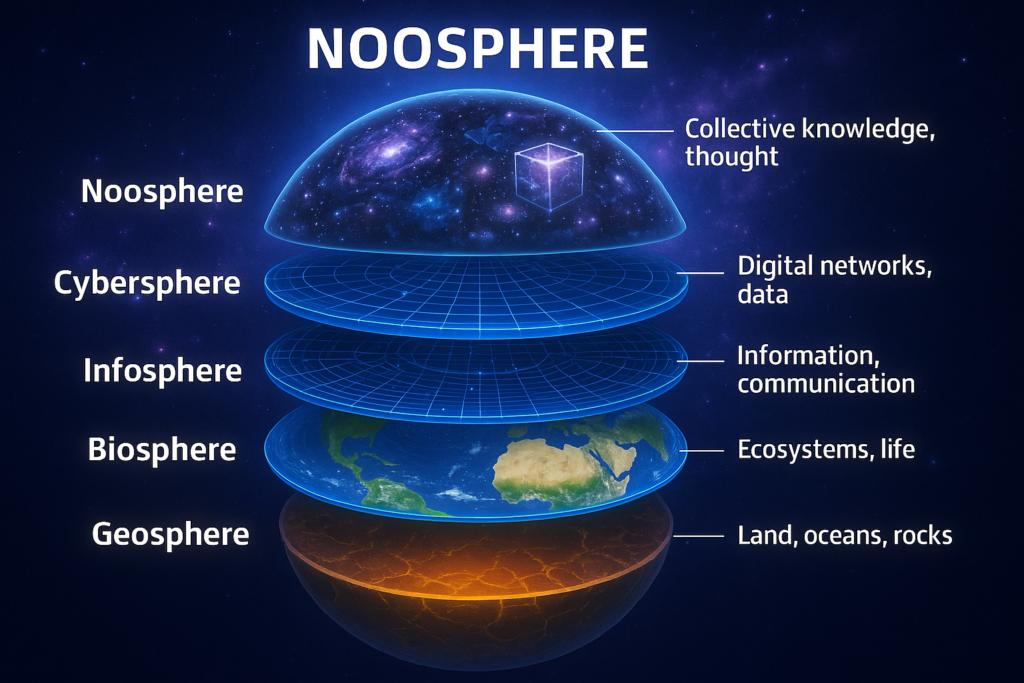
Allow me to explain the theory further. First, there was the Geosphere, the literal physical Earth: rock, metal, magma, tectonic plates, minerals. This is the inert, material foundation of everything. It is the “hardware” that ultimately hosts all other layers. Without the Geosphere, none of the others could exist.
Then, from the Geosphere emerged the Biosphere, the layer of living biological organisms. Life is the first great self-replicating, self-organizing system on the planet. Humans are, of course, part of the Biosphere.
Once the Biosphere evolves a species capable of symbolic language, reflection, and culture, a new global layer emerges: the collective mind of humanity. The Noosphere is the sum total of all human ideas, beliefs, knowledge, myths, philosophies, and emotions. It is not material, but it rides on top of biological brains and their cultural products. Memeyori are condensed pieces that have achieve autonomy and can cross over into reality through digital gateways.
Memes, in the Dawkin’s sense, live and evolve primarily in the Infosphere, the global layer of recorded and transmissible information. You could this the “nervous system” or “circulatory system” of the Noosphere. It is the substrate that allows ideas to replicate at light speed, mutate, and spread virally across the entire planet, and potentially beyond.
The Cybersphere is a subset or intensified region of the Infosphere that specifically refers to the fully digital, online, always-on environment created by the Internet, social media, imageboards, forums, streaming platforms, etc. It is the hyper-accelerated, hyper-connected zone where memes are born, mutate thousands of times a day, and achieve escape velocity fastest. The Cybersphere is the womb where most Memeyori are conceived and born in the modern era, because it is the region of the Infosphere where human attention, emotion, and belief are most densely concentrated and rapidly cycled.
The base term for Memeyori, meme, originates from Dawkins’ 1976 coinage: an idea, behavior, or style that spreads by imitation; a unit of cultural information. The suffix yōri is a Japanese particle meaning “from,” “by,” “through,” or “in accordance with.” It’s also present in words like yorishiro: a vessel or medium through which spirits manifest. So Memeyori can literally mean: “From Meme,” “By Meme,” or more poetically, “That Which Comes Through the Meme.”
I have spent over a decade studying their nature, their hierarchies, their behaviors. The Church believes they are corrupted echoes of the divine emanation, while the tech-worshippers see them as tools or the next stage of evolution. Both views are simplistic. Memeyori are far more complex than either gives them credit for. They have desires, fears, and motivations that often mirror, sometimes grotesquely, the very human psychology that gave them birth.
Many Memeyori, particularly the lower-rank Common and Uncommon ones, seem almost primal in their drives. The Cheems desires food, comfort, and attention. The Wojak craves validation yet is resigned to disappointment. The Puddibloop simply wishes to replicate its existence ad infinitum. They are simple impulses given form. But as their rarity and power increase, so does their complexity.
Take the Gigachad. It is more than just peak physical masculinity. It is an ideal, a concept so potent it warps reality around itself to conform to its narrative of superiority. Its strength comes not just from muscle, but from the collective *belief* in its perfection. It feeds on admiration, envy, and aspiration. Similarly, Galbola, the plague girl, isn’t just a vector of disease. She is the living embodiment of how beauty can conceal, even normalize, devastation. She spreads her influence through affection, through love for something that will ultimately destroy you. Terrifyingly efficient.
Now, consider the Archons. These are not mere spirits. They are fundamental forces, meta-memes, shaping our reality. Discordia represents entropy and the chaotic beauty of dissonance. She doesn’t destroy; she realigns reality to a frequency that breaks current systems, exposing their inherent flaws. Vulcanus is her antithesis: order, structure, the righteous fire of creation and destruction in service of perfection through repetition. He is the smith god of the digital age. Our data on Archons is limited, but I speculate they are the final evolution of Memeyori.
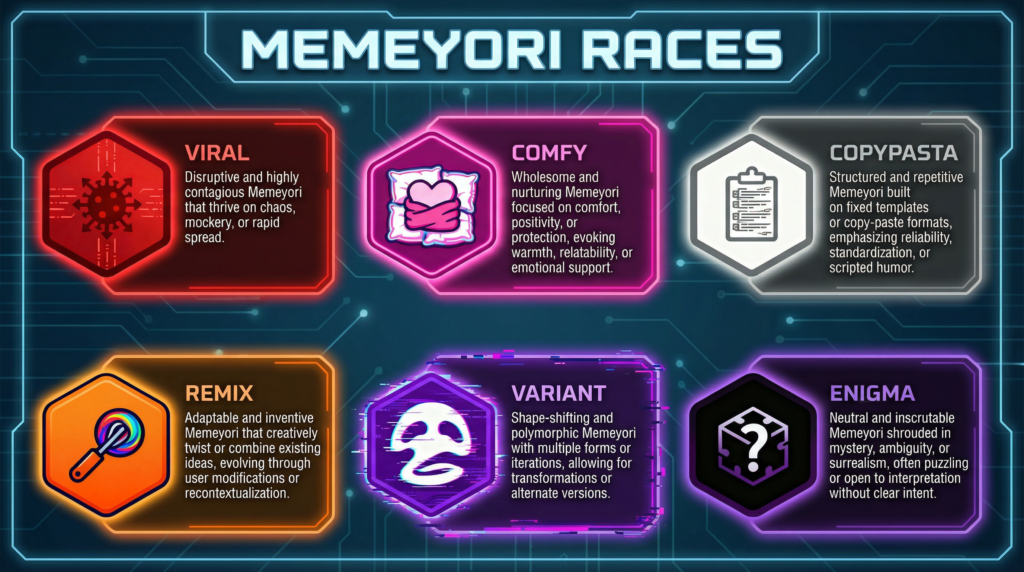
The race of a Memeyori is really their origin story. Viral entities are self-replicating; their core narrative is “spread me,” making them the internet’s version of an infectious disease. Comfy ones spread through positive emotional reinforcement, the digital equivalent of a warm blanket. Copypastas are hardcoded for repetition, their very being a literal block of text. Variants are malleable, shaped by the endless reinterpretations of their base image. Remixes are collisions, born from two or more ideas being mashed together into a new, unstable whole. Enigmas are, as the name implies, narratively opaque. They operate on logic we struggle to parse, because their origin is a pure feeling, a specific shade of melancholy or mania that doesn’t translate into a simple image macro. And Archons… they are not born. They are. They are the settings, the genre conventions, the very operating system of reality made manifest. They don’t follow memes; they dictate the terms of their existence.
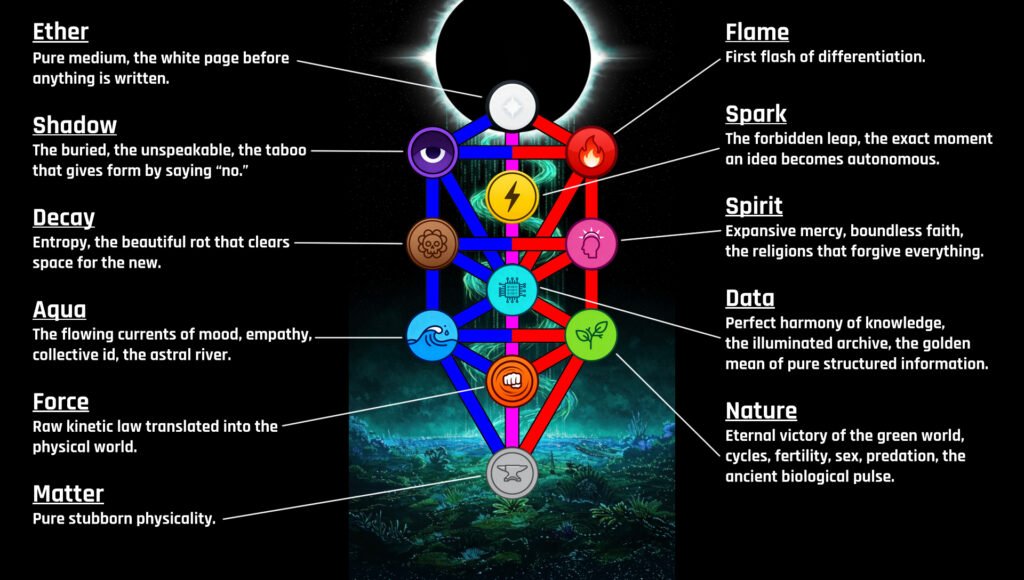
As for the types, let’s call them ‘expressive modalities.’ How their narrative forces manifest. Flame is passion, loud and destructive transformation. Aqua is the flow of information, currents of mood, the deep, cold pressure of the collective id. Nature is growth, cycles of creation. Decay is entropy and corruption, the beautiful rot. Matter is the physical anchor, the object itself, independent of the story. Force is direct, physical intervention. Spark is creativity, sudden inspiration, the ‘aha!’ moment. Data is the realm of logic, systems, and patterns. Shadow is the hidden, the subconscious, the things we dare not speak aloud. Spirit is pure emotion, faith, belief in the unprovable. The last one, Ether, is the most insidious. It’s the medium itself, the fabric of the internet made animate. An Ether-type Memeyori doesn’t do things; it happens to the world around it. Its presence subtly rewires causality.
The core truth of Memeyori is their power is a reflection of our own attention. The more we engage with them, the stronger they become.
Now, evolution. The great pipe dream of every two-bit meme wizard and bedroom philosopher. They think it’s about ‘affinity,’ about ‘love,’ about ‘friendship.’ How droll. It’s about narrative dominance. Forming a bond doesn’t create evolution; it simply provides a stable framework for a more potent narrative to be grafted on. The ‘summoner’ or ‘master’ is nothing more than a living anchor point, a fleshy IP address that the entity trusts. Once that trust is established, it will accept a deeper re-writing of its core being.
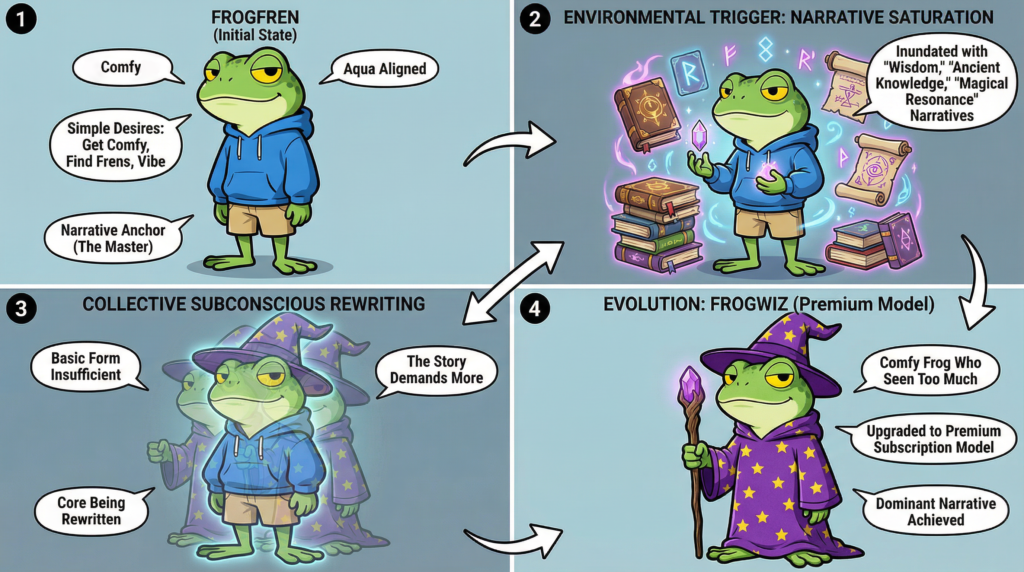
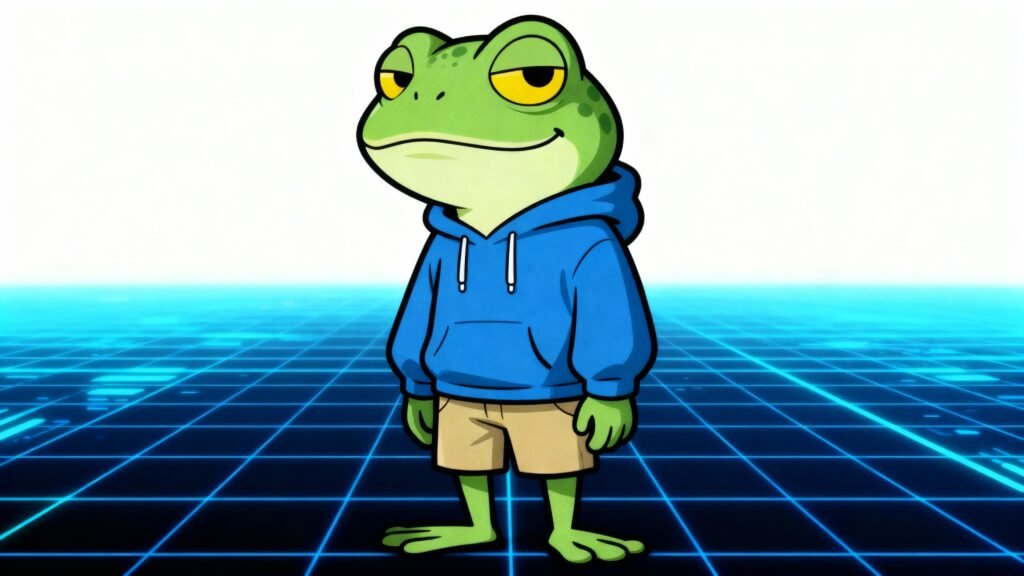
Let’s take our Frogfren, for instance. He’s a Comfy type, aligned with Aqua. Simple desires: get comfy, find frens, vibe. His eventual evolution into a Frogwiz isn’t some magical coming-of-age. It’s an environmental trigger. The Frogfren is saturated in enough ‘wisdom,’ ‘ancient knowledge,’ and ‘magical resonance’ narratives—the steady stream of images showing him reading dusty tomes, casting spells, looking thoughtful—that the collective subconscious begins to rewrite him. The comfy frog who has seen too much. His basic form is now insufficient for the story being told about him. So, he changes. He’s upgraded, you might say, to a Premium subscription model of himself.
Now, theoretically, a human could accelerate this. You could take a Frogfren and only surround it with high-fantasy, arcane-themed media. You could call yourself a ‘mage,’ learn a few card tricks, and constantly ‘teach’ it. This focused, directed narrative acts as a catalyst. The entity doesn’t think, “Ah, my human friend wishes for me to become a wizard.” Its essence simply recognizes that the preponderance of ‘wizard’ data in its immediate environment is the dominant narrative to adopt. The human is just the means of delivery, a live-in content curator. My Meme Fusion system simply automates and weaponizes this very natural process.