The Wood That Remembers
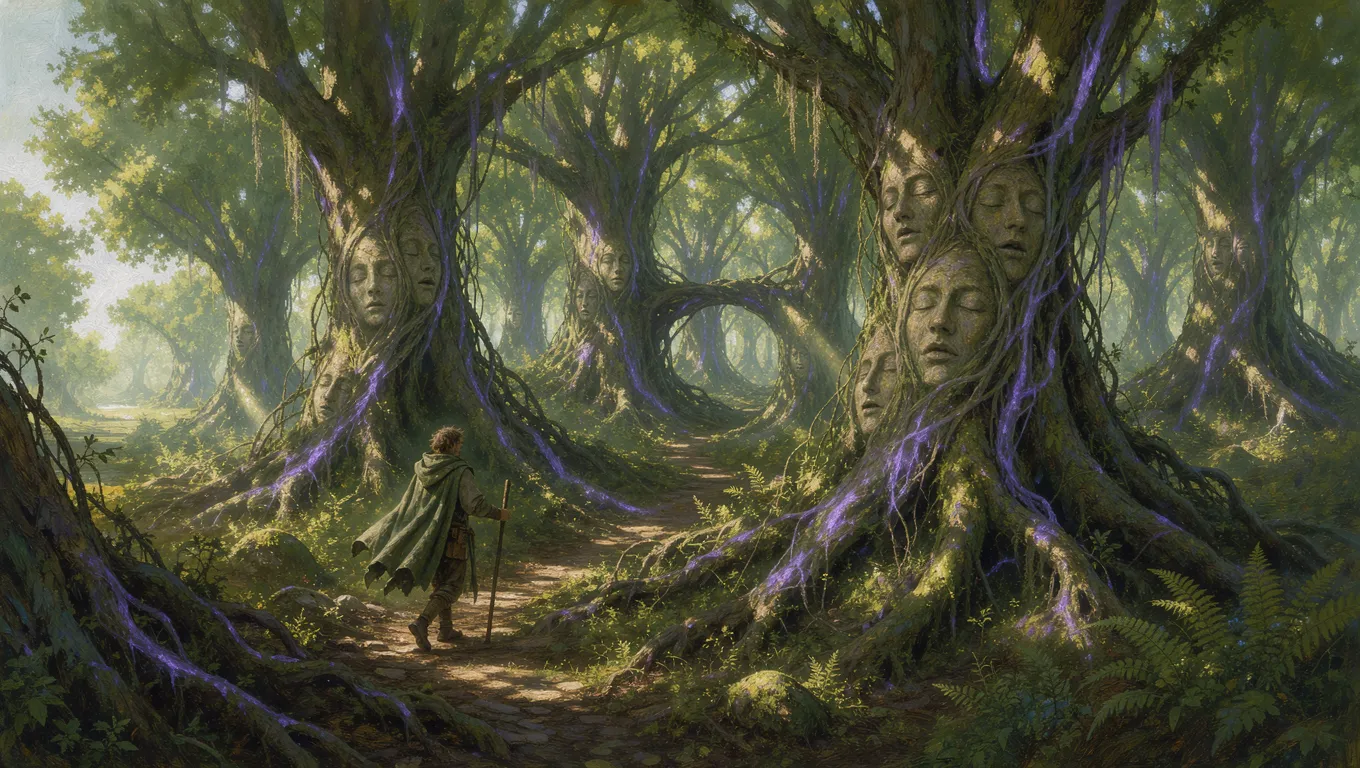
Most people come to Verdant Wyrd expecting a forest, and that is the first mistake. They arrive with hiking boots and water bottles, with the grammar of parks and trails and scenic overlooks still humming in their throats, and they stand at the edge of the treeline waiting for something to be managed — a path to follow, a sign to read, a bench to rest on. But the wood does not manage. It remembers.
Call it a forest and you flatten it into acreage. Call it a grove and you shrink it into a picnic spot. The people who tend this place, the ones who have earned the right to call it home, will tell you something stranger: the wood is a single organism, vast and slow and impossibly patient, and its body is made of memory. Not the tidy, catalogued memory of archives and photo albums, but the living kind — the kind that shifts in your chest when a smell ambushes you on a random Tuesday, the kind that knots your jaw when you try to speak a name you haven’t said in years. That is what grows here. That is the soil, the sap, the sinew.
The roots are woven from grief. Not the abstract grief of philosophy seminars, but the specific, heavy, unglamorous grief of real loss — the empty chair, the unsent text, the door you still expect to open. Every mourner who has walked these paths has left something in the earth, whether they meant to or not. A tear that fell while no one was watching. A breath that came out as a sob and was absorbed by the moss. A story told to a tree because there was no one else left to tell it to. The roots drink all of it, and they grow. They grow toward each other, tangling, braiding, until the distinction between one grieving person’s pain and another’s becomes as meaningless as the distinction between one root and its neighbor. Underground, everything touches.
Above, the canopy is dense with the weight of what we refuse to forget. That is the strange inversion most visitors miss: in the ordinary world, forgetting is relief. We are taught to move on, to find closure, to let time heal wounds that were never meant to be healed cleanly. Here, the opposite is true. The canopy does not grow toward the light; it grows toward the weight. Every kept memory, every stubborn refusal to let a loved one dissolve into the past, adds a layer of foliage. Every anniversary marked, every name whispered to the bark, every small ritual of remembrance performed without irony or audience — these are the leaves. The forest is heavy with them. It is supposed to be heavy. That heaviness is not a burden the wood endures; it is the wood.
Walk beneath those branches and you will feel it — the pressure of all that accumulated memory pressing down like weather. It is not oppressive. Or rather, it is oppressive in the way a held hand is oppressive: constant, present, impossible to ignore, but refusing to let go. The light that filters through the canopy is dappled and old, as if it has been filtered through years before it reaches you. The air smells of damp earth and something else, something you cannot name but recognize anyway. Pine. Rain. The particular scent of a place where tears have been absorbed so many times that the ground itself has learned to smell like grief. Not the sharp, fresh grief of a recent wound, but the settled, almost sweet grief of a wound that has been carried long enough to become part of the carrier.
This is not a place you visit. That is the other mistake. A place is somewhere you go and then leave, carrying nothing but photographs and a vague sense of pleasant tiredness. The wood does not allow that. It takes something from you the moment you enter — a memory you thought you had buried, a face you had convinced yourself you had forgotten — and in exchange, it gives you something you did not know you were carrying. The exchange is not always comfortable. The wood does not care about your comfort. It cares only that you remember.
And that is why it is not a forest at all, not really. A forest is a collection of trees. This is a single organism, vast and slow and impossibly patient, and its name is not Verdant Wyrd. Its name is everything you have ever lost. Its name is everything you have refused to let go. Its name is the ache you carry into the treeline, the ache you will carry out, the ache that will grow a little heavier with every step because the wood has recognized you, has claimed you, has added your grief to its roots and your refusal to forget to its canopy.
You will be part of it now. Whether you stay or whether you leave, whether you believe a single word of what the grove’s keepers tell you, the wood has already begun to remember you. And it will not stop. It cannot stop. That is what it is for.
Grief as the Only Honest Prayer
You come to the grove in pain, and the grove does not flinch from you. That is the first thing you notice. There is no gentle greeting, no soft-spoken promise that it will all be better soon, no hand on your shoulder guiding you toward the light. The wood receives you the way the earth receives a seed — without commentary, without judgment, without any particular hurry. And this, more than anything, is what the uninitiated misunderstand about the whole of Verdant Wyrd’s theology. They arrive expecting a balm. They leave with their hands full of soil and their hearts full of something they cannot name, and they wonder, sometimes years later, whether they ever actually left at all.
The keepers will tell you, if you ask them plainly, that mourning is not a stage. It is not the first step in a five-step process that ends in acceptance and a tidy sense of closure. It is not something you move through, like a fever, until you emerge on the other side cured and smiling and ready to rejoin the world of the living. The theology of the wood is older and stranger than that, and it begins with a single, heretical claim: that grief is not the obstacle to healing. Grief is the prayer itself. The only honest prayer. The only one that reaches the roots.
Think about what you actually do when you mourn. You do not recite words. You do not kneel in a designated posture. You weep, or you rage, or you sit in stunned silence with your hands open and empty. You remember. That is the core of it — you remember, and remembering hurts, and the hurt is the point. Each shed tear is not a waste of water. Each sob is not a failure of composure. Each night you lie awake tracing the outline of a face you will never see again is not a malfunction of your mind. All of it is fuel. All of it is prayer. The canopy drinks it down like rain and sends it up through the roots and the branches and the leaves, and the wood grows a little denser, a little taller, a little more present because you had the courage to hurt out loud.
This is what the laity understand and the outsiders never quite grasp: the grove does not want your hope. Hope is easy. Hope is cheap. Hope is the coin you toss into a fountain and forget by the next morning. Grief is the thing you carry. Grief is the thing you feed. And the wood, being a living memory-organ rather than a passive collection of trees, is hungry for exactly that. It does not need your belief. It does not need your optimism. It needs your sorrow the way a fire needs air, the way a root needs water, the way a child needs a hand to hold. Bring it your pain, and the wood will take it. Bring it your pain, and the wood will grow. Bring it your pain, and somewhere in the canopy a new leaf will unfurl — green, wet, and impossibly alive — and that leaf will be your grief, given form, given place, given a home in the vast slow body of the organism that remembers everything.
For those who come to the grove in pain rather than hope, this is the gospel. Not a gospel of comfort. Not a gospel of release. A gospel of permission. You do not have to get better. You do not have to move on. You do not have to smile through the ache or pretend that the wound has healed when it still weeps. You can come as you are — broken, angry, hollow, raw — and the wood will not turn you away. It will not tell you that your mourning has gone on too long. It will not suggest, gently or otherwise, that it might be time to let go. It will simply fold you into its roots and let you be exactly what you are: a person who loved something and lost it, and who refuses, with every cell of their being, to pretend that the loss does not matter.
And here is the mystery that the wood teaches, slowly, patiently, to those who stay — that grief, carried long enough, ceases to be a weight and becomes a kind of presence. It stops being something you haul behind you and starts being something that walks beside you. It stops being the thing that hollows you out and starts being the thing that fills you. Not because the ache goes away. It never goes away. But because the ache becomes part of the texture of who you are, like the grain of a tree, like the rings that tell the story of every drought and every flood the tree has survived. You do not move past your grief. You grow around it. You grow into it. And the wood, having taken your tears into its roots and your memories into its canopy, grows right along with you — a single organism, vast and slow and impossibly patient, fed by everything you refuse to forget.
So come to the grove in pain. Come with your eyes red and your voice hoarse and your hands shaking. Come with no hope at all, if that is the truth of you. The wood does not require hope. It requires only that you mourn — honestly, openly, without apology — and that you understand, in the marrow of your bones, that this mourning is not the thing standing between you and healing. It is the healing. It is the only healing that the wood knows how to give. It is the only healing that the wood has ever needed. Weep, and the canopy grows. Weep, and the roots drink. Weep, and you are praying — the only honest prayer, the one that the wood has listened to since the first human buried their dead beneath the first tree and refused to walk away.
Deed-Vows and Season-Earned Clergy
And so the vows. Not spoken. Never spoken. There is no covenant of words in this grove, no liturgy recited from a worn book, no catechism to memorize and recite back to a patient elder. The vow is a season’s worth of labor, a year’s cycle of turning and tending, of arriving when the frost still bites the early morning air and leaving when the light fails and the stars come out to watch you stumble home. The vow is made in blisters that split and heal and split again. In the particular ache of a back that has bent to the same task a hundred times. In the calluses that map your devotion across your palms like a cartographer’s marks across unknown country.
Each spring, the laity returns to the forest’s edge and makes their offering: not words, not promises, not declarations of intent that could be broken with a shrug and a forgetting. They make an action. They take up the rake, or the spade, or the pruning saw, and they work. And the work itself is the vow. It cannot be lied about. It cannot be performed falsely. You cannot fake the sweat that soaks through your shirt, cannot counterfeit the ache in your shoulders that follows you to your bed at night, cannot pretend the hours you have spent kneeling in the damp earth among the roots. The forest knows. The forest always knows. It reads you not in your confessions but in your labor, not in your prayers but in your posture, not in your faith but in your fidelity to the turning of the seasons.
And what of the clergy? Those who have been ordained, who wear the mantle of authority, who stand before the gathered faithful and offer guidance and interpretation and the weight of their experience? Their authority is not granted. It is not conferred by any ceremony, not bestowed by any bishop, not sealed by any rite of anointing. It is earned. It is measured, precisely and unforgivingly, in the number of autumns they have weathered beside the same roots. In the winters they have endured without faltering. In the springs they have returned to, again and again, when the soil was frozen and the wind cut through their coats and the work seemed pointless and the grief seemed bottomless and still they came.
The elder who has kept vigil beside the oldest oak for thirty years speaks with a different weight than the newcomer who arrived last month with a head full of theories and a heart full of unexamined pain. The elder’s authority is not in their ordination — there is no ordination, no ceremony, no moment of laying on of hands that transforms a layperson into a cleric. The authority is in the accumulated witness. In the thousands of hours of labor that have shaped their hands and their heart and their understanding. In the autumns they have seen come and go, the leaves they have watched turn and fall and rot and feed the soil, the griefs they have held and released and held again. They do not stand above the laity. They stand among them, but they stand differently. They have been weathered. They have been shaped. They have become, through the slow and brutal alchemy of time and labor, something the forest recognizes.
A season. That is the smallest unit of clerical authority. One autumn, worked honestly, beside the roots — that grants a whisper of understanding. Five autumns, and the whisper becomes a voice. Ten, and the voice carries weight. Twenty, and the elder speaks and the forest itself seems to lean in, seems to listen, seems to acknowledge that here is one who has paid the price of knowing. The season-earned clergy are not appointed. They are accumulated. They are the ones who did not leave when the grief became unbearable, who did not flee when the work became thankless, who did not abandon the grove when the first flush of novelty wore off and only the labor remained. They are the ones who stayed. And staying, it turns out, is the only ordination that matters.
The laity’s deed-vows are renewed each year, not by choice but by necessity. The forest does not hold onto last year’s promises. The soil does not remember your service from twelve months ago. The roots do not credit your account with the work you did in seasons past. Each year is new. Each year the vow must be remade, reforged, re-earned through fresh labor and fresh grief and fresh commitment. The laity does not swear an oath that binds them forever. They swear, with their hands, in the present tense, every single day they show up. And when they stop showing up — when the grief has been processed or the season has passed or the call of other obligations grows too loud — the vow simply dissolves. Not broken. Not betrayed. Simply un-repeated. The forest does not punish. It does not judge. It simply grows. And the one who has left is remembered, in the way the forest remembers everything, but they are no longer fed by it. They no longer feed it. They have become, gently and without drama, a piece of the past.
The authority of the clergy, too, is subject to this same law of renewal. The elder who has weathered twenty autumns cannot rest on that accomplishment. The forest does not honor seniority. It honors presence. The elder who stops coming, who retires to a warm house and a comfortable chair, who speaks of the grove in the past tense as if their work were complete — that elder loses their authority. Not through any formal mechanism, not through any vote or decree, but through the simple and unforgiving arithmetic of the seasons. The forest notices who is there. The forest remembers who is there. And the forest feeds only those who feed it.
So the clergy are not elevated. They are exposed. They stand before the laity not because they have been chosen but because they have endured. Their authority is the authority of the scar, the callus, the weathered face that has known the same wind for decades. They do not preach with words. They preach with their presence, with their persistence, with the simple and profound fact of their having stayed. And when they speak, the laity listens — not because the elder is anointed, not because the elder holds a title, but because the laity can see, in the elder’s hands, in the elder’s eyes, in the elder’s quiet and unshakeable certainty, the evidence of a life given to the work. The forest has marked them. The forest has taken them in. And the forest does not mark those who do not belong.
A Living Liturgy for the Unsilent
So what does worship actually feel like here, in this grove that refuses to be a metaphor?
It begins with the hands. The rake is not a symbol; it is a tool with a worn wooden handle that has absorbed the sweat and grief of a hundred strangers. You grip it, and the grain of the wood presses against your palm like a memory that doesn’t belong to you yet. The soil is dark, almost black, and it smells of decay and promise in equal measure — the sharp tang of fallen leaves breaking down, the mineral breath of earth that has been turned and turned again. You stand at the edge of a clearing, and the canopy above you is not static. It shifts, it breathes, it leans toward you as if it can hear the weight you are carrying. And maybe it can.
The rhythm of the rake is the liturgy. Pull, lift, turn. Pull, lift, turn. The motion is ancient, older than any scripture, older than any god. It is the motion of a body doing what a body can do when the mind cannot find words. You do not have to believe anything to rake. The rake does not ask for your creed. It asks only for your arms, your breath, your willingness to move through the same small arc of labor again and again. And in that repetition, something loosens. Not the grief — the grief stays, it should stay — but the grip you have on it. The tightness around your chest, the knot in your throat, the way you have been holding your sorrow like a clenched fist. The rake opens your fingers. The soil receives what you cannot say.
The silence here is never empty. That is the first thing the unconverted notice, and the last thing the converted learn to trust. There is the sound of the rake against the earth, a soft and rhythmic scrape. There is the whisper of wind moving through leaves that have not yet fallen. There is the occasional creak of a branch, the rustle of something small and alive in the underbrush. And beneath all of that, there is a deeper sound, almost subaudible, like the hum of a vast and patient organism slowly digesting the world. It is not the silence of an empty room. It is the silence of a living thing listening. You do not feel watched in the grove; you feel attended. There is a difference. To be watched is to be judged. To be attended is to be held.
And so you rake. You do not pray with words, because words have failed you before. You pray with the arc of your back, with the blisters forming on your palms, with the sweat that drips from your forehead and disappears into the soil. You pray with the tears that fall, unannounced, unbidden, and are absorbed by the very ground you are tending. You pray with your refusal to leave, with your stubborn and unglamorous presence in a place that has no roof, no walls, no altar — only the living memory of everything that has been given to it. The forest does not care if you believe in it. It cares that you are here. It cares that you are feeding it. And it will feed you in return, not with answers, not with comfort, not with the false promise of healing — but with the simple and profound fact of its own persistence. The forest has been here longer than you have been grieving. It will be here after your grief has become part of its soil. And in that enormous, unblinking patience, you find something you did not know you were looking for. Not hope. Hope is too small a word. You find the possibility of staying. The possibility of returning, tomorrow and the day after, to the same patch of ground, to the same worn rake, to the same silence that is never empty. You find the possibility of becoming, slowly and without ceremony, part of the organism — not by believing in it, but by showing up for it. By raking. By mourning. By refusing to forget. That is the whole of the liturgy. That is the whole of the path.
So come. Come without faith. Come without hope, if hope is too heavy a burden. Come with your grief, your anger, your doubt, your exhaustion. Come with nothing but your hands and your unwillingness to let go of what you love. The forest will not ask you to believe a word of it. The forest will only ask you to stay. And if you stay long enough, if you rake long enough, if you mourn long enough — the forest will teach you why you came. Not in words. In soil. In silence. In the slow and certain turn of the seasons. That is the only promise the grove makes, and it is the only one worth keeping.
The Grove Where Grief Works
The rake’s tines scrape against gravel and root, a sound like breath forced through clenched teeth. I drag them through the wet leaves, and the smell rises — damp earth, decay, the particular sweetness of things returning to themselves. My hands are cold inside the worn leather gloves. The ground is soft from last night’s rain, and my boots sink a little with each step, leaving prints that fill with dark water almost immediately.
I am not praying. That is the thing I have to keep telling myself, because old habits die hard and my mouth still wants to form the words I no longer believe. But the body has its own language, and it is speaking now in the rhythm of the rake, in the bend and straighten of my spine, in the way I lift each armful of wet leaves and carry it to the compost heap at the edge of the grove. The gesture is almost liturgical. The offering is made without a word being said.
The grove is patient with me. That is the first thing it teaches, though I do not understand it yet. The oaks stand in their centuries of stillness, their bark furrowed like the faces of old men who have stopped asking questions. The light falls in shafts between their branches, thick with floating dust and the smoke of my breath. A jay calls somewhere to my left, sharp and mocking. I ignore it. I am here to work, not to listen — though even as I think this, I know it isn’t true. I am here to listen. I am here to do the only thing I know how to do anymore.
The leaves cling to the ground like grief clings to memory. I pull them up by the handful, feeling the cold moisture seep through the fabric, feeling the small lives that scatter underneath — woodlice, centipedes, the blind white threads of fungi that connect everything in this place to everything else. I do not understand the forest. I have stopped trying to understand it. Understanding is a luxury I cannot afford, a door that has closed behind me and left me standing in this grove with nothing but my hands and the work they have to do.
That is the tension, and I feel it in my shoulders, in the ache that spreads from my wrists to my elbows to the base of my neck. The belief is gone. The presence remains. The words have failed, but the soil does not care. It accepts what I give it — the leaves, the sweat, the small obscene weight of the hours I spend here — and it gives back only what it has always given: the slow work of becoming, the patient rot, the promise that what is broken will eventually be folded into something that grows.
I stop raking for a moment. I stand in the middle of the grove, the rake leaning against my shoulder like a rifle no one has taught me to fire. My breath comes in clouds. The trees do not move. The silence is not empty — it is full of small sounds I have learned to hear: the creak of a branch, the drip of water from a leaf, the distant sound of traffic that belongs to another world entirely. I am not praying. But I am present. And in this moment, that is enough.
The grove does not care if I believe in it. It cares that I am here. It cares that I am feeding it. And it will feed me in return — not with answers, not with comfort, not with the false promise of healing — but with the simple and profound fact of its own persistence. The forest has been here longer than I have been grieving. It will be here after my grief has become part of its soil. And in that enormous, unblinking patience, I find something I did not know I was looking for.
Not hope. Hope is too small a word. I find the possibility of staying. The possibility of returning, tomorrow and the day after, to the same patch of ground, to the same worn rake, to the same silence that is never empty. I find the possibility of becoming, slowly and without ceremony, part of the organism — not by believing in it, but by showing up for it. By raking. By mourning. By refusing to forget.
That is the whole of the liturgy. That is the whole of the path. So I come. I come without faith. I come without hope, if hope is too heavy a burden. I come with my grief, my anger, my doubt, my exhaustion. I come with nothing but my hands and my unwillingness to let go of what I love. The forest does not ask me to believe a word of it. The forest only asks me to stay. And if I stay long enough, if I rake long enough, if I mourn long enough — the forest will teach me why I came.
Not in words. In soil. In silence. In the slow and certain turn of the seasons. That is the only promise the grove makes, and it is the only one worth keeping.
Words Fail, Soil Remembers
I have tried prayer. I have tried the words that are supposed to hold grief like cupped hands hold water. The old words, the inherited ones, the ones my grandmother whispered when she thought no one was listening. I have knelt on the damp forest floor and spoken them aloud, and the sound of my own voice was so small, so thin, that it seemed to evaporate before it reached the first row of trees. The syllables hung in the air for a moment — a wisp of breath in the cold — and then they were gone, and the forest did not notice. The forest has never once noticed my words.
What did I expect? That the trees would lean in, their bark like ears, catching the frequency of my sorrow? That the moss would absorb my confession and turn it into something green and living? That the wind would carry my precise articulation of pain to whatever god or void listens, and that something would answer, if not with comfort then at least with acknowledgment? I spoke at the forest for months. I gave it my best sentences, my most honest metaphors, my carefully crafted laments. I said the same things over and over, as if repetition would eventually wear a groove into the silence, as if the forest were a stone and my words were water.
The forest was not a stone. It was not anything I could wear down. And my words — they did not feel like water. They felt like ash. They felt like the dry husks of things that had once been alive, rattling in my mouth. Every time I tried to say what I had lost, the loss itself seemed to recede, to become less real, less heavy. The language was a thin membrane stretched over a wound, and every word I pressed against it made the wound smaller, more manageable, more distant. I did not want my grief to become smaller. I wanted it to be seen. I wanted it to be held. I wanted it to exist in the world outside my body, in the world with other people, in the world with the trees. But language did not carry it outward. Language carried it inward, compressing it into a neat, portable shape that I could carry without bleeding. And that was worse. That was a betrayal.
So I stopped speaking. Not all at once, not with any grand resolve. I simply ran out of words. I was standing at the edge of the grove, my mouth half open, and I realized there was nothing left to say. I had used them all. I had spent my vocabulary on the wrong things — on the description of pain rather than the pain itself, on the story of what happened rather than what was still happening, on the naming of a wound so precisely that I had made it smaller than it truly was. I closed my mouth. And for the first time in months, I was silent. Not the silence of waiting, not the silence of holding something back. Just silence — an empty space where speech had been.
And in that silence, my body began to speak.
This is what I did not understand when I was still trying to pray. I did not understand that the body has its own liturgy, its own grammar, its own way of saying what the mouth cannot. The body does not lie. The body does not edit. The body does not choose its metaphors with care. It simply moves — and in its moving, it confesses. I knelt. I plunged my hands into the cold, damp soil. I pulled up a handful of wet leaves, and I squeezed, and the water ran between my fingers, and I knew I was crying even though my eyes were dry. I dug my fingers deeper, feeling the roots, the stones, the buried seeds. I pressed my forehead to the ground, and I did not say anything, and the forest received me anyway — my weight, my heat, the moisture of my breath against the dirt. I was speaking. I was speaking with everything I had except my voice.
There is a word for this. There is a word for the way the body remembers what the mind cannot say. I have heard it in some lecture, some article, some half-remembered conversation. Somatic. It means of the body. It means knowledge that lives in the flesh. I did not know I had such knowledge until I knelt down and my knees remembered what my heart could not articulate. My knees remembered kneeling. They remembered kneeling at the edge of a bed, at the foot of a graveside, in the front of a chapel. They remembered the pressure of hard ground and the ache of long vigil. My hands remembered. They remembered the shape of a hand I would never hold again. They remembered the weight of a tool, the rhythm of work. My back remembered the particular fatigue of carrying. My shoulders remembered the tension of holding something up, something heavy, something I was not allowed to put down. My body was a library of grief, and I had been walking through it with my mouth open, asking it to read me a story, when it had been trying to tell me everything all along.
I stopped kneeling. I stood up. I looked at the forest — the same trees, the same patch of ground, the same damp light. But I looked at it differently. I looked at it as a witness. Not a witness to my words, which had been empty, but a witness to my body, which had been honest. The forest had seen everything. It had seen me arrive, day after day, with the same grief and the same failure to express it. It had seen me try to pray and give up. It had seen me kneel and press my forehead to the ground. It had seen the particular angle of my shoulders when I looked at the place where the person I loved had once stood. The forest had recorded all of it. Not in words — the forest does not keep a ledger, does not write a diary, does not carve anything into its bark except the passage of years. But the forest had recorded it in the only way anything can truly be recorded: by being there. By not looking away. By remaining present while I remained present, and by holding the memory of my presence in its soil, in its roots, in the subtle shift of its ecosystem as I wept and worked and refused to leave.
The soil remembers. This is not metaphor. This is not poetry. The soil literally remembers — the weight of footsteps, the pressure of a kneeling body, the chemistry of tears and sweat and the particular salts of grief. The soil is a record. It is a slow, patient, unwritten archive of everything that has ever touched it. I have read that archaeologists can dig down through layers of earth and find the evidence of ancient fires, ancient floods, ancient feet. The soil preserves. It holds. It does not forget. And I thought — standing there, no longer trying to say anything, just standing — I thought of all the things I had been trying to say to the forest, all the words that had failed, and I realized that the forest had heard me anyway. Not through my mouth. Through my body. Through the pressure of my knees. Through the heat of my forehead against the loam. Through the salt of my tears, soaked into the ground, becoming part of the soil’s chemistry, altering the pH of a square inch of earth in a way that would last for years. I had been praying all along. I just hadn’t been praying in the right language.
The body is the first language. It is the language we learn before we learn words, the language we use before we learn to lie. It is the language of the infant reaching for its mother, of the child curling into a lap, of the adult pressing their face into the hands of the person they love and cannot bear to lose. And it is the language of grief — the language of the mourner who cannot speak, who can only kneel, who can only press their body against the ground and trust that the ground will hold them. I had been so desperate to find the right words that I had forgotten I had a body at all. I had been so focused on the failure of language that I had missed the success of the body. The body had been doing the work all along. The body had been holding the grief when the mind could not. The body had been carrying the sorrow in the curve of its spine, in the knot of its shoulders, in the particular way it stood at the edge of the forest and looked at the trees without saying anything at all.
The forest does not have a language either. Or rather — the forest has a language, but it is not a language of words. It is a language of root systems and mycelial networks, of chemical signals passed between trees, of the slow exchange of nutrients through the soil. It is a language of presence. The trees do not speak to each other in the way we speak. They do not say, I am thirsty, or I am afraid, or I am losing someone I love. They communicate through the soil, through the underground web of fungi that connects their roots, through the leaving of chemical traces that another tree can read, not with eyes but with the whole of its being. And I understood, standing there, that this was the language I had been trying to speak all along. Not English. Not prayer. Not the careful articulation of loss. But the language of presence — the language of being there, of showing up, of leaving a trace in the soil that another being could read without needing a single word.
I have stopped trying to say anything. I have stopped trying to explain my grief to the forest, or to anyone, or even to myself. I have stopped trying to translate the ache into something that can be spoken and heard. Instead, I let my body speak. I let my hands speak, when they pick up the rake and begin the slow, repetitive work of clearing leaves. I let my knees speak, when they bend to pull a weed from the soil, when they press into the damp earth in the position of prayer. I let my back speak, when it aches from labor, when it remembers the ache of carrying a casket, when it holds the grief in the particular way it has learned to hold it. And the forest answers. Not with words. The forest answers with the feel of soil under my hands, with the sound of wind in the branches, with the particular weight of a rake that has become familiar. The forest answers the way the body answers — not with explanation, but with presence. Not with meaning, but with being.
The soil remembers what I cannot say. The soil remembers the pressure of my grief, the chemistry of my tears, the weight of my body as I knelt and tried to find a way to speak. The soil remembers the day I gave up on words, and the day I found my body instead, and the day I understood that I had been speaking all along. The soil holds it all. Not in a ledger, not in a diary, not in any form that can be read or quoted or repeated. But in the way soil holds everything — quietly, patiently, without judgment, without expectation. The soil does not ask me to explain. The soil does not ask me to find the right words. The soil only asks me to touch it, to kneel in it, to leave my trace, and to return. And so I return. I return with my body, with my silence, with the unspoken confession of my kneeling. I return and I press my hands into the ground, and I let the soil hold what I cannot say. I let the soil remember what I cannot speak. And in that remembering, something in me begins to settle. Not to heal — I am not sure I want to heal. But to settle. To find its place. To become part of the ground that holds me, the ground that remembers, the ground that does not need my words to know that I have been here, that I am here, that I will be here again.
Against Hope, Toward Staying
Everyone asks if I’m feeling better. The question arrives with such certainty, such confidence in its own usefulness, as if hope were a switch I’ve simply forgotten to flip, as if healing were a destination I’ve somehow missed on the map. But I’ve stopped looking for the road to it. The grove doesn’t offer directions. It offers only the path I’m already on, the one worn soft by my own repeated footsteps, the one that leads not away from grief but deeper into its center, where the mourning is not something to escape but something to inhabit.
Hope, I’m learning, is a cruel currency here. It demands payment in the future, in the promise of a day when the weight will lift, when the loss will soften into something manageable, when I will wake and not reach for the absence first thing. That day may come. It may not. The forest doesn’t care either way, and I’m beginning to see the wisdom in that. Because hope has kept me looking toward a horizon I cannot see, while the ground beneath my feet — this actual, real, present ground — goes untended.
I rake. I pull weeds. I clear the fallen branches that block the light. I do these things without expecting them to change me. And somehow, in that lack of expectation, something shifts anyway. Not healing, exactly. Not hope. Something quieter, more stubborn — a willingness to stay in the place I am, even when that place is hard, even when the staying feels like failure because I’m not moving toward the version of myself everyone keeps telling me I should become.
The trees don’t rush. They don’t check their progress against some imagined ideal of what a tree should be by now. They grow where they were planted, bend toward whatever light reaches them, and let the storms reshape them without complaint. I want that. Not the stoicism — the surrender. The acceptance that I don’t get to choose the pace of this, the shape of it, the outcome of it. I only get to choose whether I keep showing up.
And the staying — that’s the part I want to insist on. Not the staying until I’m better, not the staying until it stops hurting, but the staying without conditions, without deadline, without the hidden bargain that says I’ll endure this if I know it will end. The grove has never promised me an end. It has only ever promised that it will be here, that the seasons will turn, that the soil will keep its quiet record of everything I bring to it. And I have decided, slowly, painfully, that this is enough. That the return itself is the devotion. That the willingness to be unfinished, to remain in the middle of something I cannot see the end of, is a form of faith — not in a better future, but in the act of remaining.
I used to think persistence was for the strong, for the ones who had some reserve of will I didn’t possess. But I see now that persistence is just another name for what the body does when the mind has given up on answers: it keeps. It breathes. It places one foot after another, not because it believes in the path, but because stopping is not an option it recognizes. I am learning to let go of hope. Not in despair. In a kind of fierce, quiet acceptance. I am learning to stay not because I expect the grief to end, but because I have begun to understand that the staying is the point. The return, the rake, the presence — this is what I offer, not to the dead, not to some god, but to the ground itself, which asks nothing and accepts everything and keeps me, day after day, in its patient, unjudging arms.
What the Soil Teaches in Silence
The first winter I spent in the grove, I tried to rake the leaves away from the base of the old oak. Some instinct toward tidiness, toward keeping things clean, toward the mistaken belief that bare soil was healthy soil. I learned, by spring, that I had been interfering with something older than my own understanding of care. The leaves I had removed were not debris. They were the tree’s own memory of itself, returning as food, as insulation, as the slow conversion of sunlight into something the roots could drink again.
The soil teaches in a language that has no verbs. Or rather, it has only one verb, and that verb is become. Everything becomes something else, given enough time and enough patience and enough stillness. The leaf that falls in October is not gone by April. It is changed — softened, darkened, broken down into the very substance that will feed the fern that unfurls in May. There is no waste in this system. There is only transformation, patient and relentless and utterly without sentiment. The forest does not mourn the leaf. It does not celebrate the fern. It simply continues the conversation that began before any of us were here to overhear it.
I think about this when I think about the loss that brought me to the grove. The shape of it, the particular weight of it, the way it once felt like a wound that would define me forever. And then I watch the soil do its work, and I understand that I have been thinking about grief all wrong. I have been thinking of it as something to survive, something to endure until it is over. But the soil does not know the word over. It knows only and then. The leaf becomes the fern. The fern becomes the humus. The humus becomes the dark, rich earth that holds the roots of the next generation of trees. Nothing is finished. Everything is on its way to becoming something else.
This is the lesson that cannot be spoken. It can only be witnessed, season after season, until the witness themselves begins to change. I have watched the same patch of ground for three years now. I have seen the mushrooms rise and collapse, the moss advance and retreat, the worms churn the darkness into new arrangement. I have seen the slow, inexorable process by which the fallen become the foundation. And I have come to understand that my own grief — the particular loss that drove me here, that I carried like a stone in my chest — is not a wound at all. It is compost. It is the dark, rotting matter that will feed whatever grows next in me, if I am patient enough to let it. If I am willing to stop trying to tidy it away, to stop trying to rake the leaves from the base of my own heart, and simply let the soil do its ancient, silent work.